
Statues and symbols are the dungeon's own language. How to read them for puzzle clues, sealed routes and the rooms players get stuck in.
Deep Dish Dungeon Statue Puzzle: How to Read the Symbols
Statue puzzles in Deep Dish Dungeon come in two shapes: figures you rotate until they face marks carved into the floor, and figures holding a plate that want one specific item. The dungeon never explains either one, so you read the room instead. Ground patterns give directions, and offerings follow the game's own food and crafting logic.
- Rotation puzzles: statues must face the direction their ground marks point.
- Offering puzzles: a plate or bowl statue wants one item placed on it.
- Craft puzzles: some carved doors need clay or wax statues you build from molds.
- Design intent: puzzles are deliberate, and the developers say the dungeon reveals itself only to patient players.
What the Statue Puzzle Actually Asks You to Do
Deep Dish Dungeon is sold as a puzzly hand-crafted dungeon with metroidvania and crafting elements, and statues are one of its main puzzle languages. They are not decoration. Each statue family hides a different rule, and that rule is always present in the room, usually carved into the floor, the walls, or the nearby door.
Official source: Deep Dish Dungeon on Steam
Here is the split players hit most often:
| Puzzle family | What you see | What it wants |
|---|---|---|
| Wax or clay statues | A set of molded figures, sometimes four, on a marked floor | Rotate each figure to face the arrows or trail on the ground |
| Plate statue | A single statue holding a plate under a beam of light | Place one specific item on the plate |
| Animal-mold door | A large door carved with animal heads | Find and place the missing molds before it opens |
| Offering table | A food item on a table that refuses to spoil | Match the food the room is waiting for |
The publisher states the intent plainly: take your time, solve every puzzle, open every door, and never take a hint for granted. That last part is the whole difficulty curve.
Official source: Deep Dish Dungeon at Raw Fury
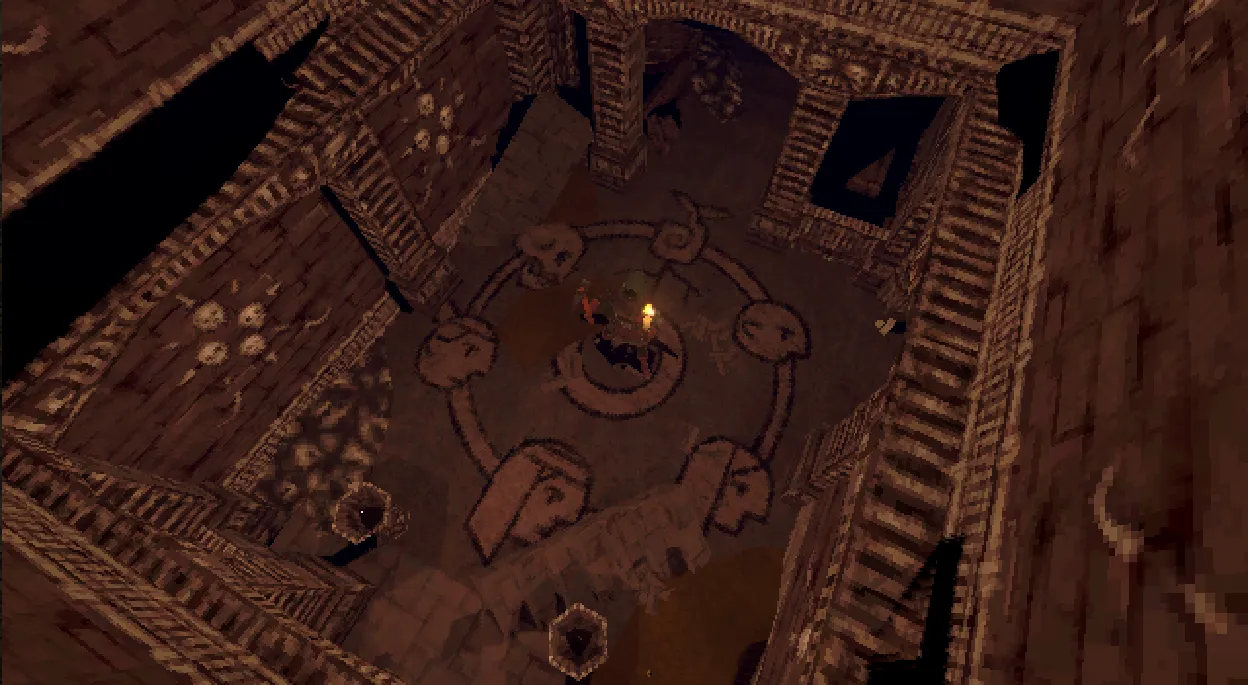
Face the Statues Where the Ground Pattern Points
The most common statue puzzle is a rotation puzzle. A player stuck in the crypts asked directly how to rotate the extra statues they had built, and the community answer was consistent: read the pattern on the floor and face each statue toward the arrows.
The method, as players describe it:
- Stand with the locked door at your back.
- Find the carved trail or arrow pattern on the ground.
- Follow the trail to its end, the tail of the path.
- Turn each statue so it faces the direction the nearby arrows point.
One thread recorded a working orientation for a door with snake heads, posted as a small grid of arrow directions. Others read the same puzzle differently, describing each statue's heading like the hands of a clock. Both readings point at the same rule: the ground holds the answer, and the door confirms it once every figure agrees.
If a statue grid refuses to open, walk back to the doorway and look at the whole floor at once. The arrow pattern usually only makes sense from the entrance, and single-statue tinkering hides it.
A player who solved it admitted they had been reading each statue in isolation, and the fix was to read the pattern as a path instead. The full exchange is public on Steam.
Official source: Steam Community discussion on mid and late game puzzles
Plate Statues and Offerings
The second family is the offering puzzle. One reported example sits near the upper ruins: a statue holding a plate, lit by a beam of light, with no obvious hint about what to place there. Players report being stuck on it for a long time, and the honest state of knowledge is that the required item is community-reported, not documented.
The clue sits in the game's own food system. A demo patch added spoilage: a single food item left out goes bad over time, usually around twenty minutes. A puzzle built around that would accept exactly one item, so if the food on a table or plate has not spoiled while everything else has, read it as a signal rather than a coincidence.
Official source: Deep Dish Dungeon Demo Update v1013 notes
Practical steps when you meet an offering statue:
- Look for light. A beam aimed at a plate is a placement marker, not decoration.
- Check nearby food and crafting materials before leaving the room.
- Compare the item that refuses to decay against what the room already holds.
- Treat any specific item list as a community lead until a patch note or screenshot confirms it.
Clay Molds and the Animal Doors
A third family needs statues you build. Players describe a puzzle door carved with a skeleton dragon and six bird-woman statues that they had to craft out of clay. Others describe an animal-mold door, a jaguar door, that will not open until the right number of molds are placed.
| What players report | Status |
|---|---|
| Six bird-woman statues crafted from clay to open a carved door | Community-reported |
| A jaguar door requiring three molds | Community-reported |
| A third jaguar mold behind rusty bars, reached by a wooden plank | Community-reported location |
| A third jaguar mold through a manhole above the smithing room | Community-reported location |
Two community members gave different routes to the same third mold, which fits this game: the map is one connected space with shortcuts, so more than one path can reach the same spot. Carry molds and keep a spare inventory slot, because these puzzles ask you to bring the object, not just spin a dial. The crafting and tools guide covers how molds and materials fit the wider workbench loop.
Symbol Rooms and Sealed Doors
Not every statue hides a puzzle. Some rooms simply speak in symbols, and your job is to read them as navigation. Official screenshots show a branching chamber marked with pale symbols on the floor and a sealed circular stone door that takes a group of players to open.
Treat symbol rooms as route clues rather than locks to force:
- Pale floor symbols often mark which branch leads where, so read them before committing.
- A sealed circular door is usually opened elsewhere, by solving the thing it guards.
- Statues that look lootable are a separate, unresolved community question, so test them rather than assuming.
This matches the mapless philosophy the developers describe for the whole game: every room needs a strong identity, and hints are meant to be noticed rather than handed over. Learning the halls by landmark makes symbol rooms far easier to place, and the dungeon guide walks through that navigation method in detail.
Official source: Deep Dish Dungeon Dev Blog #8 - A Dungeon That Feels Real
The orientations and mold locations above are community reports from the current build. Puzzle layouts and item requirements can change in patches, so verify in your own game before farming materials toward a posted solution.
Solve Any New Statue Room in Five Steps
A repeatable method beats memorizing someone else's arrow grid:
- Read the floor first. Look for arrows, trails, or symbols before touching a single statue.
- Check the statue's hands. A held plate, bowl, or offering slot means an item puzzle, not a rotation puzzle.
- Count the statues. A set of three or four usually wants orientation; a lone figure usually wants an offering.
- Test with cheap items. If a plate wants food, try what the room already contains before farming rare ingredients.
- Leave and return with tools. Animal-mold doors reward preparation, so note them and come back with molds or keys.
If a room still refuses after all five, the answer is often somewhere else. This dungeon is a single connected space, so a statue you cannot solve today is frequently waiting on a shortcut or a tool you have not found yet. The beginner guide is a good refresher on the early camp-to-dungeon loop, and the demo ending guide explains where the free demo's puzzle path stops.
FAQ
What goes in the statue holding a plate?
Players report a statue near the upper ruins with a light shining onto its plate, but no confirmed item list exists. Treat the plate as an offering slot: test food and materials the room already contains, watch for the one item that does not spoil, and treat any specific answer as a community lead.
How do I rotate the crypts statues?
Read the carved pattern on the ground. Stand with the locked door at your back, follow the trail to its tail, and face each statue toward the arrows it points to. That method comes from players who solved it, and it beats guessing at individual figures.
Are there four statues or three in the deep crypt?
Players report having three and asking whether a fourth is needed, and the honest answer is that the exact count for the deepest room is community-reported and unclear. Bring what you can build and check the room's floor pattern for the number of marked positions.
Does the statue puzzle need clay or wax?
Some statue puzzles do. Community reports describe clay bird-woman statues and molded figures built to open carved doors, so crafting materials and molds matter here, not just orientation. The crafting and tools guide covers how molds fit the workbench.
Related Guides
- Dungeon Guide - Landmark navigation that makes symbol rooms and sealed doors far easier to read.
- Crafting and Tools Guide - Molds, materials, and the tools that open the paths statue puzzles guard.
- Demo Ending Guide - Where the demo's puzzle path ends and what the final sanctuary shows.
- Beginner Guide - The early camp and dungeon loop if the statue systems still feel opaque.
- FAQ - Quick answers on maps, saves, and how the game expects you to explore.
More Deep Dish Dungeon Guides
The Deep Dish Dungeon demo is free on Steam for Windows with no time limit. Download steps, demo content, v1013 notes, and save transfer rules.
Handcrafted dungeon with no map or compass. Navigate by landmarks, lighting, shortcuts and vertical links, plus tool-gated paths and safe routes.
Demo enemies include archive skeletons, with 15 variants across 5 kinds per community datamine. Verified encounters, honest counters and patch caveats.
Deep Dish Dungeon FAQ: October 13, 2026 launch, free demo rules, price status, Game Pass, saves, map, co-op size, Mac, and cooking explained.
Clay matters early for crafting and camp upgrades. Where players report finding it, what it builds, and honest notes on unverified spots.
Saving works mid-run: stop, save and load later. How save files behave, what carries into the full game, and co-op progress notes.
Your inventory is small on purpose. Slot pressure, what to carry, backpack and death pack rules, and where your loot goes when you die.
What press and players say about Deep Dish Dungeon difficulty, friction, co-op and value, plus who should wait a patch before buying.