
Handcrafted dungeon with no map or compass. Navigate by landmarks, lighting, shortcuts and vertical links, plus tool-gated paths and safe routes.
Deep Dish Dungeon Dungeon Guide: Learn the Halls by Heart
The dungeon is handcrafted, and you explore it without a map or compass. The developers confirmed that deliberate choice in a Steam dev blog: no minimap, no quest arrow, just distinct rooms, landmarks, lighting cues, shortcuts, and vertical connections to memorize. That sounds harsh until you learn the method. Read rooms instead of coordinates, chain landmarks into routes, and carry the right tools for gated paths, and the halls start feeling like a neighborhood instead of a maze.
- Core fact: handcrafted layout, no map, no compass, by design.
- Navigation: distinct rooms, landmarks, lighting, shortcuts, vertical connections.
- Progression: tool-gated paths reward capability over stats.
- Flavor: environmental storytelling fills the gaps the UI leaves empty.
No Map, No Compass: What That Actually Means
Most crawlers hand you a minimap and call it exploration. Deep Dish Dungeon refuses. Without a map or compass, orientation becomes a skill: you learn the dungeon the way you learn a real building, by walking it until junctions feel familiar. Early runs feel slow because every corner demands attention. Later runs feel fast because memorized routes compress ten minutes of creeping into two minutes of striding.
This design punishes two habits. First, sprinting past everything on run one and expecting run two to make sense. It will not. Walk the first descents, look at rooms, and name junctions in your head. Second, relying on guides for turn-by-turn directions. Text directions through a mapless dungeon age badly and read worse. A landmark chain like campfire stairs, bone chamber, statue sanctuary survives patches and confusion far better than left-left-right ever could.
The honest upside is real. Mapless navigation makes the dungeon feel enormous, makes shortcuts feel earned, and makes your tenth descent genuinely different from your first. Players who commit to learning the halls report the classic crawler arc: lost, then oriented, then fluent, then fast. There is no shortcut past the lost phase. Budget your first sessions for it.
Official source: Deep Dish Dungeon announcement on Steam
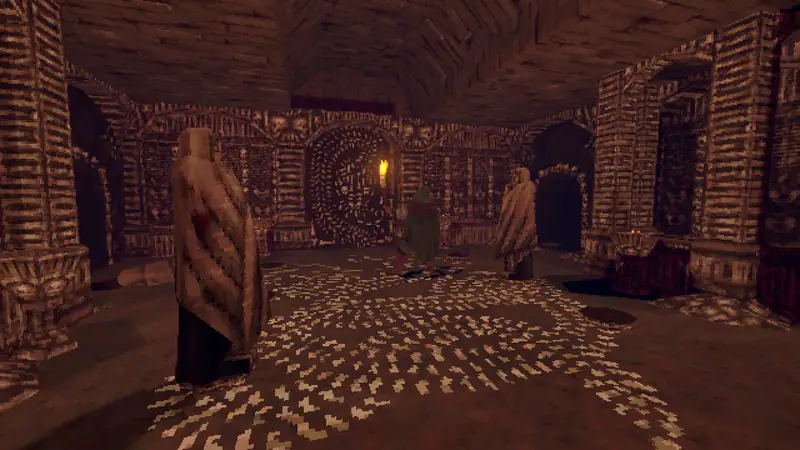
Navigate by Landmarks, Light, and Distinct Rooms
The developers built navigation aids into the architecture itself. Rooms are visually distinct rather than tiled from one corridor kit, lighting guides the eye toward points of interest, and set-piece chambers anchor whole regions. Your job is to notice and remember.
Distinct rooms. Every major chamber has a visual identity: bone-strewn floors in one, archive shelves in another, worked stone and statues elsewhere. When rooms look different, routes become stories. You do not memorize coordinates; you remember that the bone chamber sits below the stairs and the archives sit past the narrow doors. Screenshot landmarks on your first visits if your memory needs help. Nobody will know.
Lighting. Light pools mark importance. Bright chambers invite, dark throats warn, and Torch light extends your reading range exactly as far as your fuel allows. A dying Torch is therefore a navigation problem as well as a combat one: dark halls all look alike. Carry a spare, and treat light management as route planning. The crafting guide covers Torch durability and spares.
The statue sanctuary. One landmark deserves its name: the statue sanctuary, a chamber of worked stone and standing figures that reads as a rest point in the dungeon body. Treat it as your underground trailhead. Routes measured from the sanctuary, two chambers past it, one level below it, stay stable in your head when everything else blurs. Rest-style chambers in crawlers traditionally sit at region boundaries, so expect the halls past the sanctuary to escalate.
Each descent, pick three junctions and give them names: bone stairs, archive doors, statue rest. Say the names aloud as you pass. Three named points per run compounds into a full mental map within a few sessions, which is exactly how mapless design expects you to learn.
Shortcuts and Vertical Connections
Handcrafted dungeons repay backtracking with shortcuts, and this one is built around them. Early paths loop slowly around hazards; later you kick open metaphorical doors, drop ledges, and climb chains that compress those loops into seconds. Vertical connections matter most: stairs, drops, and hook-ledges stitch levels together so a deep chamber sits one climb from camp instead of ten corridors away.
Prioritize shortcut discovery over loot on early runs. An opened shortcut pays dividends on every future descent, while one more bundle of loot pays once. Push until you find the loop-closer, mark it mentally against your nearest landmark, then farm with the shortcut active. This is also where traversal tools earn their keep: ledges that need the grappling hook often hide the best vertical links, so hook-ready players map the dungeon an entire dimension faster.
Expect the pattern to continue downward. Region boundaries in this kind of design usually pair a sanctuary-style rest with a shortcut back up, letting you bank progress before the next tier. When you find a rest chamber with no obvious loop home, the loop exists and you have not found it yet. Keep looking before pushing deeper.
Tool-Gated Paths
Some doors do not open for stats. Tool-gated paths need the right implement: the grappling hook for marked ledges, and community-reported gates like the hammer path toward the Prison Key route. Gating by capability instead of numbers keeps early halls relevant, since a new tool reopens old rooms with new options, and it means progression planning is about tools first and damage second.
Handle the two evidence grades differently. Hook ledges are confirmed by screenshot prompts: see the LEDGE marker, hold [LMB], profit. Hammer gates and key routes are community-reported and unconfirmed, so explore them as leads. Note which walls look interactable, remember them against landmarks, and test whatever the workbench offers when you return. For the full confirmed-versus-reported breakdown, the tools and crafting page keeps the ledger.
One practical consequence: never declare an area finished. New tools retroactively unlock old halls, so each upgrade should trigger a revisit lap through familiar rooms. The dungeon you mapped with empty hands is a different dungeon with a hook on your belt.
Environmental Storytelling
Without quest markers, the dungeon tells its own story through placement. Bone chambers say something died here in numbers. Archive shelves with armed skeletons say knowledge was guarded, and guarded badly or well depending on how the fight goes. Statues in a sanctuary say someone built rest into the deep on purpose. None of this needs a journal entry to matter: it tells you what kind of room you are in and what to expect next.
Read remains like warnings. Massed bones suggest whatever made them might still visit. Barricaded doors suggest something worth barricading. Arranged objects suggest intelligence, recent or otherwise. This reading habit doubles as survival sense, because the dungeon telegraphs danger through set dressing long before enemies appear. New players rush past scenery; veterans slow down at it, and veterans keep their health bars.
The enemies guide continues this thread with the archive skeletons as a worked example: placement, engagement, and what the room teaches. For the systems you prepare before descending, cooked stat-changing meals pair naturally with long mapping sessions where fights are a distraction from learning.
Official source: Deep Dish Dungeon on Steam
Safe Route Habits for Mapless Delves
- Always know your last landmark. Before entering any new throat, turn around and memorize the view back. Exits look different from behind.
- Descend fed and lit. A cooked meal and a fresh Torch are navigation gear, not luxuries. Hunger and darkness both cause the mistakes that kill mapless runners.
- Open loops before loot. Shortcuts first, treasure second, deep pushes third.
- Revisit on every upgrade. New tools reopen old rooms. Schedule a familiar-halls lap after each workbench tier.
- Watch the news feed. Layout-affecting patches get announced; check the Steam announcement feed and the Raw Fury hub before relearning halls that a patch may have reshuffled.
Community maps drawn for one build may mislead in the next, and turn-by-turn directions rot fastest of all. Prefer landmark chains from version-tagged posts, verify shortcuts yourself each patch, and never trust a map with no build number attached.
FAQ
Is there a map in Deep Dish Dungeon?
No. The developers confirmed no map and no compass in a Steam dev blog, as a deliberate design choice. Navigation runs on distinct rooms, landmarks, lighting, shortcuts, and vertical connections. Learn junction names and light cues instead of waiting for UI help that will never come.
How do I stop getting lost without a compass?
Name three junctions per run, memorize the look back at every new entrance, and anchor routes to big landmarks like the statue sanctuary and the bone chamber. Open shortcuts before farming so every route compresses. Most players go from lost to fluent within a few sessions once they navigate by landmarks instead of turns.
What are tool-gated paths?
Passages that need a specific tool rather than stats: grappling-hook ledges (confirmed via the LEDGE prompt) and reported gates like the hammer path toward a Prison Key route (community-reported, unconfirmed). Carry tools, revisit old halls after each upgrade, and treat community gate reports as leads to verify in your build.
Does the dungeon change between patches?
Layout-affecting changes arrive through patches, and community maps can go stale without warning. Check version-tagged posts and the official announcement feed before trusting a detailed map, and re-verify your shortcut chains after each update.
Related Guides
- Crafting and Tools Guide - Hook ledges and gated paths decide your routes, so learn confirmed tools versus reported ones.
- Enemies Guide - Archive skeletons and other demo threats with honest counters for mapless runners.
- Demo Ending Guide - Know where the demo descent ends so your mapping sessions aim at the real finish.
More Deep Dish Dungeon Guides
How the Deep Dish Dungeon demo ends, what the thank-you screen means, and what the Prison Key door route still needs to confirm.
Deep Dish Dungeon FAQ: October 13, 2026 launch, free demo rules, price status, Game Pass, saves, map, co-op size, Mac, and cooking explained.
Deep Dish Dungeon news timeline: Raw Fury deal, February demo, Xbox Game Pass news, v1013 patch, and the October 13 2026 launch.
Deep Dish Dungeon launches October 13, 2026 on Steam and Xbox with day one Game Pass. Platforms, Play Anywhere, price status, and demo details.
Deep Dish Dungeon PC requirements: Windows and macOS for the full game, Windows-only demo, plus how to check specs on Steam.