
New to Deep Dish Dungeon? Five steps from first camp to first feast: cook dishes, craft tools, read the UI, find hidden paths, and join co-op runs.
Deep Dish Dungeon Beginner Guide: Your First Camp to First Feast
Your first hour in Deep Dish Dungeon follows five steps: set up camp, cook a dish, craft a tool, find a hidden path, and optionally join an online expedition. Cooking gates progress, so eat before you explore. The full loop clicks once you treat the campfire as mission control.
- Camp first, cook second, explore third, every single run
- The UI shows a 1-6 hotbar plus health and stamina, with [E] to interact, [B] for crafting, and [F] to drop
- No map and no compass, so memorize landmarks from the start
- Solo or online with up to 2 friends, 3 players maximum
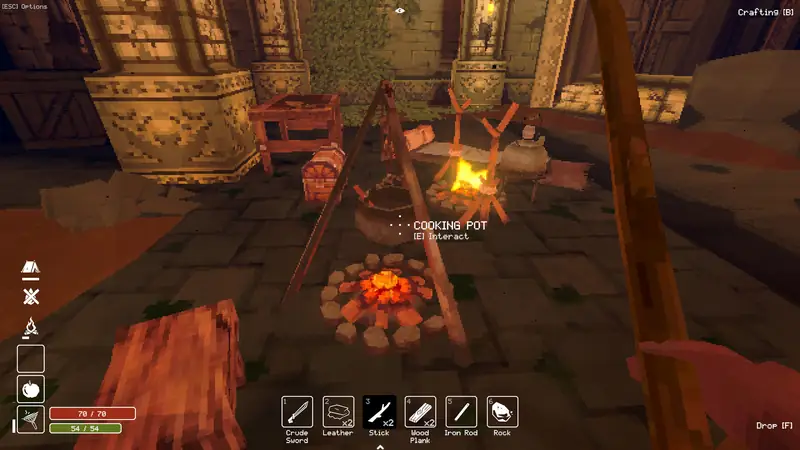
Step 1: Set Up Your First Camp
The camp is your safe hub between descents. Nothing down there wants you fed and rested, so handle both before leaving. Rest to recover, sort your inventory, and confirm your hotbar holds what the next run needs.
Developer Behold Studios, with publisher Raw Fury, built the game as a first person survival dungeon crawler where cooking opens the way. The studio also describes the concept as a survival metroidvania, meaning new dishes and tools unlock previously closed routes.
Official source: Deep Dish Dungeon at Raw Fury
Keep camp visits short but regular. New players often push one room too far with empty stamina and no spare food. Retreat early, cook what you gathered, and descend again stronger. The dungeon rewards repeated prepared runs over single desperate pushes.
Step 2: Cook Your First Dish
Cooking is the main progression lever. Interact with the campfire using [E], combine the ingredients you scavenged, and eat the result. Some dishes restore you, while others unlock paths or encounters that stay closed to a hungry crawler.
Start with whatever grows or drops near camp. Early ingredients are forgiving, and the first recipes teach the combining logic without punishing experiments. Try pairs you have not tried yet, because the discovery itself is part of the system. Community members report large recipe totals from inspecting demo files, but those community-reported counts vary by build and carry no developer confirmation, so explore for yourself instead of chasing a checklist.
Cook and eat at camp before each descent. Dishes that gate doors or buff a run only help if they are active when you reach the obstacle, and backtracking hungry wastes the trip.
Watch what each dish actually does. One meal might boost stamina for a long climb, another might let you pass a hazard. Read the result text carefully and match the meal to the route you plan next. Over time you will build a mental menu of which dish solves which problem.
Step 3: Craft Your First Tool
Open the crafting menu with [B] and assemble your first tool from scavenged parts. Basic tools extend what you can do in the dark: pry, light, cut, or reach things bare hands cannot. Craft at camp where parts are plentiful rather than improvising mid dungeon.
The keys below are the only ones this guide states, because they are the ones visible in official screenshots. Anything beyond this list should be learned from the in game prompts, not from memory.
| Key | Action |
|---|---|
| [E] | Interact with campfires, items, and points of interest |
| [B] | Open the crafting menu |
| [F] | Drop the held item |
| 1-6 | Select hotbar slots |
Official source: Deep Dish Dungeon on Steam
Press [F] with care. Dropped items land where you stand, which is convenient at camp and painful over a ledge. If you must juggle inventory mid run, stop somewhere flat first. The [B] menu pauses your planning but not necessarily the dungeon, so craft before descending rather than during a chase.
Carry one spare tool whenever parts allow. Tools wear down or get consumed at the worst moments, and the walk back to camp eats more time than the extra weight ever costs. New players lose more runs to empty hands than to hard fights.
Step 4: Find the Hidden Path
The dungeon is handcrafted, with no map and no compass. Progress comes from observation: draft on your face, light under a door, bones piled against one wall, a statue facing somewhere odd. The demo and early full game areas both teach this language through level design rather than tutorials.
Pick three landmarks near the entrance on your first descent and memorize them. A bone pile, a torch sconce, a sealed circular door, any fixed feature works. Narrate routes relative to those points until the layout feels automatic. Players who skip this step spend their second hour lost in rooms they already cleared.
Revisit old rooms after every new dish or tool. The survival metroidvania structure means yesterday's dead end opens with today's meal. Make rechecking a habit: each time you cook something new, walk the previous area once before pushing further. Hidden paths cluster around the early zones precisely to reward this behavior.
Official source: Steam Community announcement for Deep Dish Dungeon
Darkness is a resource problem, not just atmosphere. Torches and light tools run out, and an unlit room hides both loot and hazards. Head back while you can still see rather than gambling the last minutes of light on one more corridor.
Step 5: Join an Online Expedition
Once the solo loop feels comfortable, try online co-op. You can run solo or team up with up to 2 friends, making 3 players maximum per session. One player hosts, the others join through the multiplayer menu, and the party shares the same campfire logic as solo play.
Decide who cooks, who carries spare tools, and who scouts ahead. A party where everyone forages the same room starves together, while a party with one cook and one scout moves twice as fast.
Note a sourcing wrinkle: Steam materials and the May 2026 fact sheet state solo or up to 2 friends, while one Raw Fury page phrases it as up to three friends. Those two wordings imply different party sizes, so plan groups around the smaller figure until launch confirms the lobby cap. Our release guide tracks this discrepancy in detail.
Co-op does not remove the survival pressure. Hunger, darkness, and dead ends challenge full parties the same way, and reviving or regrouping costs time. Communicate landmark callouts the same way solo players memorize them, since a lost teammate without shared reference points slows everyone.
UI Basics: Hotbar, Health, and Stamina
The HUD stays minimal. Slots 1 through 6 form the hotbar for food, tools, and light sources. Health and stamina bars sit nearby and drain from damage, hunger, and exertion. Everything else lives behind menus, so the screen stays clear for spotting secrets.
Keep food on the lowest numbered slot you can reach blindly. When health drops mid fight or stamina fades mid climb, you will not have time to hunt across the bar. Tools go in the middle slots, light sources at the far end, and everything follows muscle memory after a few runs.
Eat before bars empty, not after. Stamina governs movement options and health forgives mistakes, but both recover slower than new players expect. Top up at camp, carry one emergency meal, and retreat while you still choose to rather than when the bars decide for you.
If any of this sounds like a lot, the free demo is the ideal training ground. It covers camp, cooking, crafting, and the opening dungeon slice with no time limit, and its separate save means practice never risks a future full game file. The FAQ answers platform and pricing questions that sit outside gameplay.
FAQ
What should I do first as a beginner?
Set up camp, cook your first dish, then craft a basic tool before exploring. Food gates more doors than weapons do.
How do I open the crafting menu?
Press [B]. Craft at camp where scavenged parts are plentiful, and carry a spare tool on every descent.
Is there a map or compass?
No. The dungeon is handcrafted with no map and no compass. Memorize landmarks like bone piles, statues, and sealed doors.
Can beginners play co-op immediately?
Yes, but learn the solo loop first. Parties hold up to 3 players total (you plus up to 2 friends), and shared campfire logic rewards crews who assign cooking and scouting roles.
Which keys do I actually need?
[E] interacts, [B] opens crafting, [F] drops items, and keys 1-6 select hotbar slots. Learn the rest from in game prompts.
Related Guides
- Deep Dish Dungeon Demo: Free Download Guide — install the free Windows demo and practice the full loop with no time limit.
- Deep Dish Dungeon FAQ: Release, Demo, Co-op — quick answers on price, saves, party size, and Mac support.
- Deep Dish Dungeon Release Date: Oct 13, 2026 — launch platforms, day one Game Pass, and the co-op count discrepancy.
More Deep Dish Dungeon Guides
How the Deep Dish Dungeon demo ends, what the thank-you screen means, and what the Prison Key door route still needs to confirm.
Deep Dish Dungeon FAQ: October 13, 2026 launch, free demo rules, price status, Game Pass, saves, map, co-op size, Mac, and cooking explained.
Deep Dish Dungeon news timeline: Raw Fury deal, February demo, Xbox Game Pass news, v1013 patch, and the October 13 2026 launch.
Deep Dish Dungeon launches October 13, 2026 on Steam and Xbox with day one Game Pass. Platforms, Play Anywhere, price status, and demo details.
Deep Dish Dungeon PC requirements: Windows and macOS for the full game, Windows-only demo, plus how to check specs on Steam.